
Since mid-2025, the Art&Inequality project has expanded its research eastward to the Republic of Ragusa (Dubrovnik). The extensive collection of the State Archives, housed in the Sponza Palace, contains over 7,000 testaments that are being studied for the project. One testament from the mid-15th century is especially interesting because of an enigma: it contains a typically vague bequest seen in the Ragusan wills, but a later note written on the same page reveals it to be one of the most detailed and striking artistic bequests that I have thus far found from the Ragusan testaments.
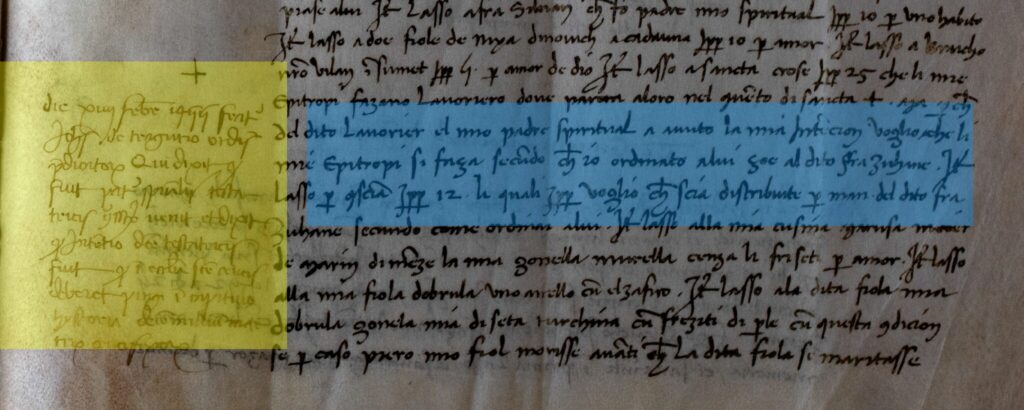
Catherine, the widow of a wealthy commoner named Vlahuša (Blasius) Latiniza, wrote her will in July 1452 while on her deathbed. Her pious bequest included several pilgrimages to holy places in Italy. She asked that two priests go to Assisi (al tempo del perdon), two others to Santa Maria in Recanati (near Macerata in the Marche region), and one priest to Rome. She left it to the executors of her last will to choose the priests for the journeys to Assisi and Recanati. However, she clearly expressed her wish that her spiritual advisor (padre spirituale), the Dominican friar John from Trogir, should go on the pilgrimage to Rome.
Only one of Catherine’s pious bequests concerns something “material” – the aspect that mainly interests us in the Art&Inequality project. She left 25 perpera to the newly built Dominican monastery in Gruž (Gravosa), the port of Dubrovnik. She instructed her executors to take care of “a work” (lavoriero) wherever they thought best within the monastery. However, since she had already explained her wishes to her spiritual advisor, John of Trogir, she urged them to follow the instructions she had given him. What exactly this bequest referred to remains unclear, as Catherine chose to keep it a secret as far as her will goes.
Bequests like this fall into a “grey area,” and a lot of the project’s discussions focus on how to classify them within the Art&Inequality system, which assigns codes for quantitative analysis. In Catherine’s case, however, there was no need for debate. A note written in the margin of the same page as the will, next to the bequest, explains everything. In a short text from February 1455, about two and a half years after the will had been notarised, Catherine’s spiritual advisor revealed her intention: she wanted to commission a painting (possibly a mural) in the chapter house of the monastery. He further specified the subject of the artwork—the Crucifixion of the Ten Thousand Martyrs (hystoria decem millium martirorum crucifixorum).
The church in Gruž, dedicated to the Holy Cross, was begun in 1427 and was largely completed by 1437, along with other parts of the monastery, like the dormitory and chapter house. The construction of the complex was supported by numerous testamentary bequests from the second quarter of the fifteenth century, made by both nobles and commoners of Dubrovnik. Shortly before the middle of the century, a large wooden crucifix was commissioned and placed on the main altar. Catherine helped deepen the devotion to the cross by supporting an artwork in the chapter house showing the Crucifixion of the Ten Thousand Martyrs. According to a 12th-century legend—which gained popularity only in the 14th century—the martyrs were Roman soldiers led by Acacius who after converting to Christianity were crucified by order of the Roman emperor.
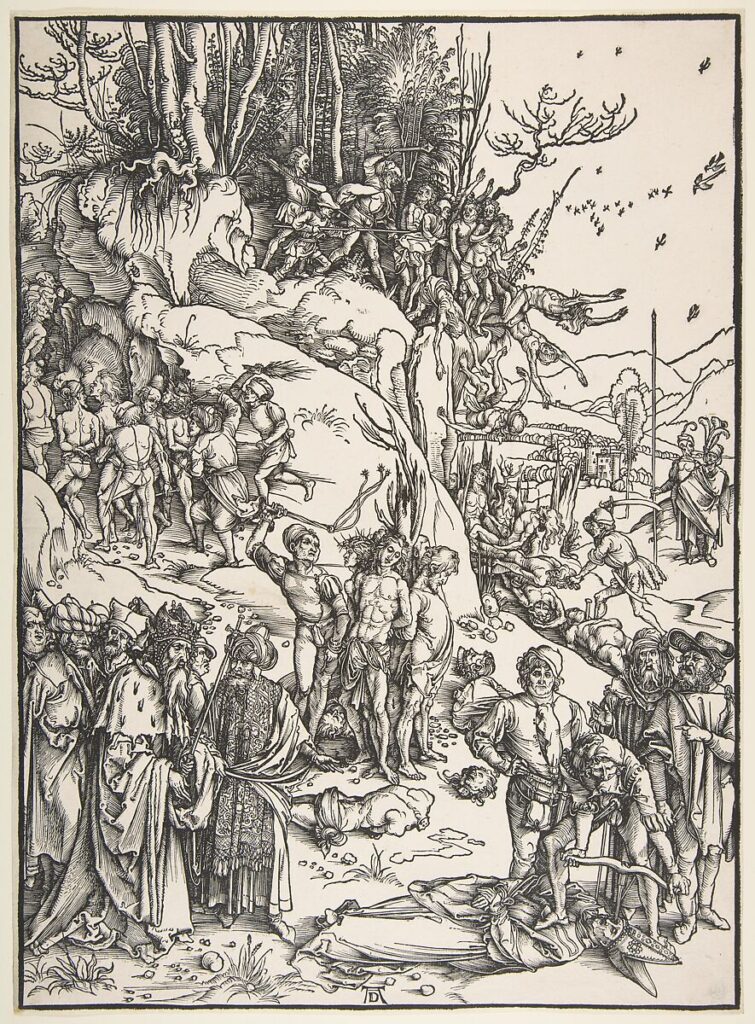
This subject gained momentum in art in the late 15th century, especially in panel paintings in Central Europe. Its recognition increased significantly following Albrecht Dürer’s well-known woodcut of 1496–97, which inspired a number of subsequent paintings, again primarily within the same region. In contrast, the theme appears only rarely in the Mediterranean; among the limited examples are works by Vittore Carpaccio produced in Venice in the early 16th century. Taken together, this context makes Catherine’s deathbed commission especially noteworthy and deserving of further study. Regrettably, the monastery in Gruž was mostly destroyed during World War II, with near-complete damage to the chapter house. At the current stage of research, it remains uncertain whether Catherine’s commission was carried out, though her intention is certainly remarkable.
Art historians often feel frustrated when reading testaments. Although there are many mentions of paintings—especially in Dubrovnik—there are rarely detailed descriptions, usually just general statements like “I want a painting to be made…” (Voglio che se faza una ancona…). Sometimes, however, as in Catherine’s case, even a few lines can open up many research questions. Yet this would not have been possible if the details of her commission had not been revealed—ironically—by the very person who was supposed to keep her secrets: her spiritual advisor.