
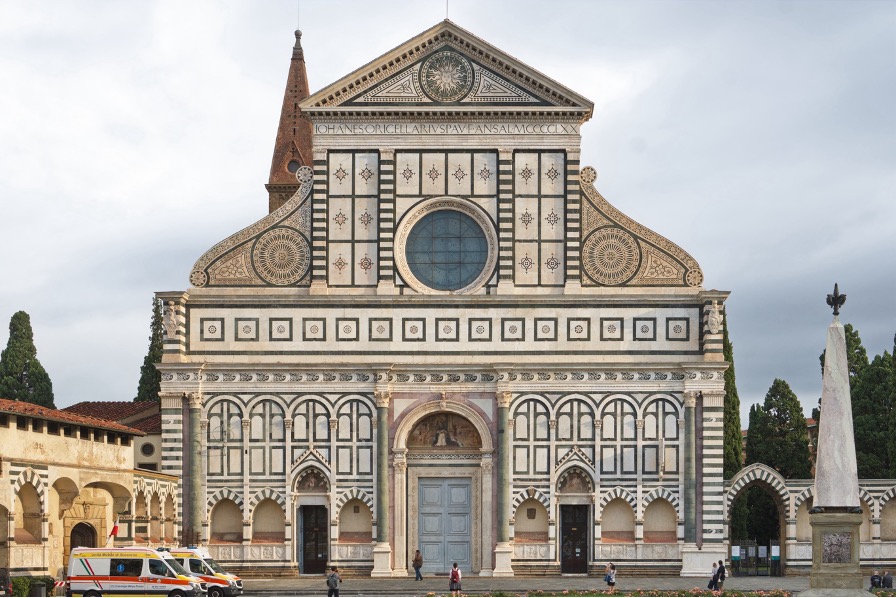
The quantitative context:
I have just finished coding the photographs of parchment testaments from the Archivio di Stato, Firenze [hereafter ASF] Diplomatico of the famous Florentine Dominican friary, Santa Maria Novella [hereafter SMN]. Their documents reach back to the late 11th century but, as with every collection within the ASF’s online Diplomatico, end abruptly in 1398.1 Compared with my previously coded testaments from Florentine Tuscany (not including Pisa and its contado),2 the SMN testaments are unusual in several respects. First, the SMN testaments are more narrowly focused on the city of Florence than other fondi in my collections from the Florentine Notarile and the Diplomatico. From the Diplomatico, Florentine residents drafted less than a third of the testaments (29.2%, 395 of 1355 testaments), and from the combined datasets, just under half (49.7%) of them. By contrast, all but eleven testators in the SMN collection were residents of Florence, constituting 91.7% of SMN’s 132 testators. Moreover, six lived of these testators resided in nearby villages of Florence’s contado, and only one hailed from beyond its districtus. He was a Hungarian nobleman, who at the time of his will resided in Santa Miniato al Tedesco, a town then within Pisa’s terre.A second unusual feature of the SMN collection concerns the social class of its testators. For Florentine Tuscany, those I have categorized as “elites” (ones with family names, titles of nobility or domini, were in the upper echelons of the church, possessed certain upper guild professions, such as judges, wool or silk merchants, or simply labelled, cives et mercatores) comprised 28.4% of the sample. If only testators from the city of Florence are considered, the proportion increases to 40.8%.
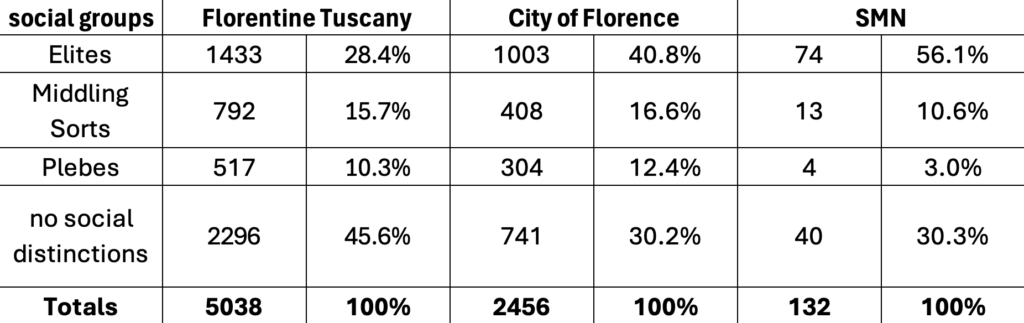
By contrast, elite testators from SMN nearly doubled the proportion found in Florentine Tuscany and were almost a third higher than elites from Florence, the city. Moreover, these testators, along with several without indications of elite status, belonged to the small parishes (populi) within Florence’s Roman city streets, where elite families clustered during the late fourteenth and fifteenth centuries: San Pier Buonconsiglio, San Miniato alle Torre, Santa Maria degli Ughi, Santa Maria Campidoglio, Sant’Andrea, San Tommaso, and others, such as San Pancrazio that bordered these ancient streets.3
Yet not all of SMN’s characteristics differed from the general pattern: the sex ratio of testators resembled closely those calculated from my other samples. For Florentine Tuscany as a whole, almost exactly a third were women (33.4%). For the city, it was slightly higher, 36.6%, which matched almost exactly SMN’s. On the other hand, the proportions between the wills drafted by married women versus widows for Florentine Tuscany and, more so, the city of Florence recalls Diane Hughes’s assessment of aristocratic women in Renaissance Genoa published fifty-one years ago: “Women came of age with widowhood.”4
However, neither Italy nor Tuscany was of one piece regarding women’s restricted liberties as some have supposed.5 The Florentine graph of the proportions between married and widowed women testatrices reveals a wide gap between the two that continued consistently throughout the three centuries of our analysis: testatrices while married rarely rose above 10 percent of women’s testaments and by the sixteenth century had shrunk to 5 percent. Pisa’s story is strikingly different: married testatrices approximated those of widows and dipped below 30 percent only a half century after Florence had ruled Pisa since 1406.
Statutory differences between the two Tuscan city-states parallel these statistics. In Florence, Lombard laws governed women’s testamentary freedoms, requiring them to have their husband’s consent or that of a male protector (mandualdus) to enact a notarized contract or will. No such laws limited Pisan women’s rights until the late fifteenth century. Instead, testamentary obligations between spouses were equal: both had to grant the other at least 15 lire. As a result of these differences, married women’s wills in Florentine Tuscany, even among elites, were brief and showed few choices beyond their bequests to their husbands.
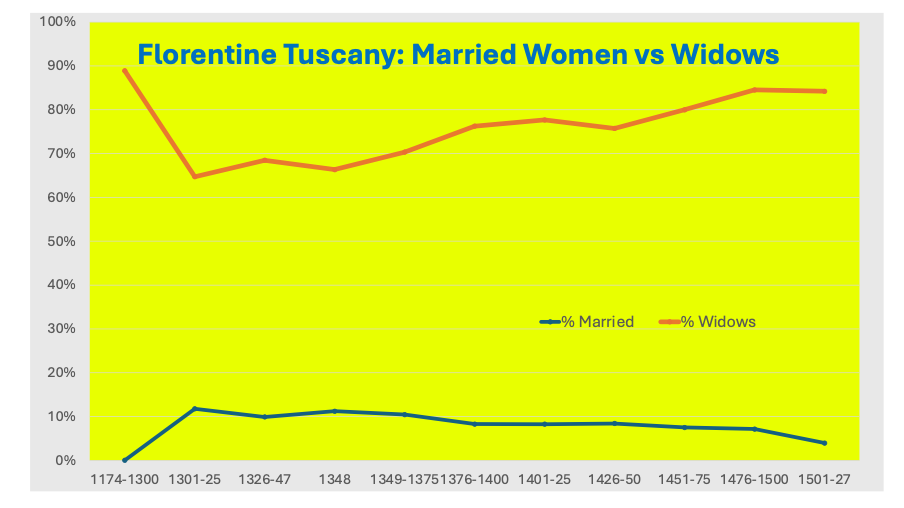
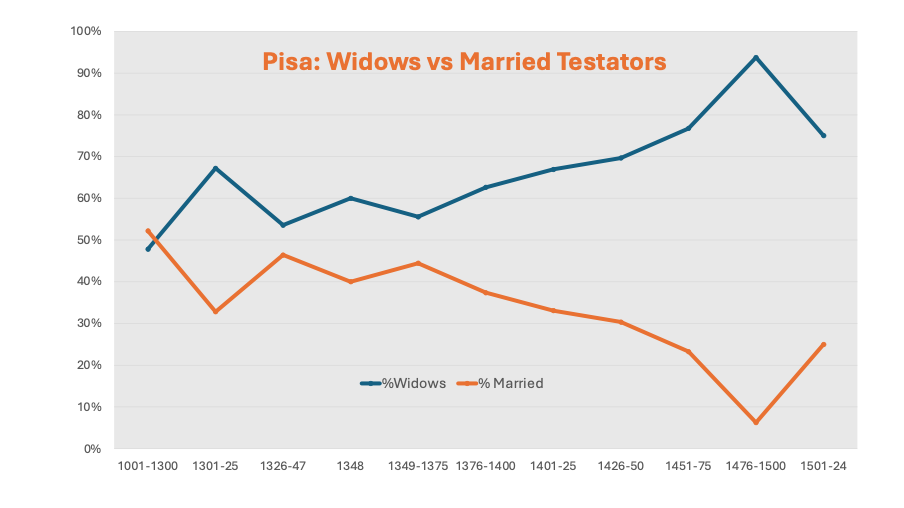
How did Florentine married women’s testaments compare with the more elite, city-focused, SMN collection? Among the 132 testators, 49 were women; of these four were single secular women, four pinzocherie who were neither married nor widowed, two were nuns, and 38 were widows, comprising 78 percent of the testatrices. This left only one married testatrix, less than 0.8% of the testators and 2% of the testatrices. This percentage was only a fifth of the already minuscule percentage of married testatrices from Florentine Tuscany.6
The Qualitative side, the Will:
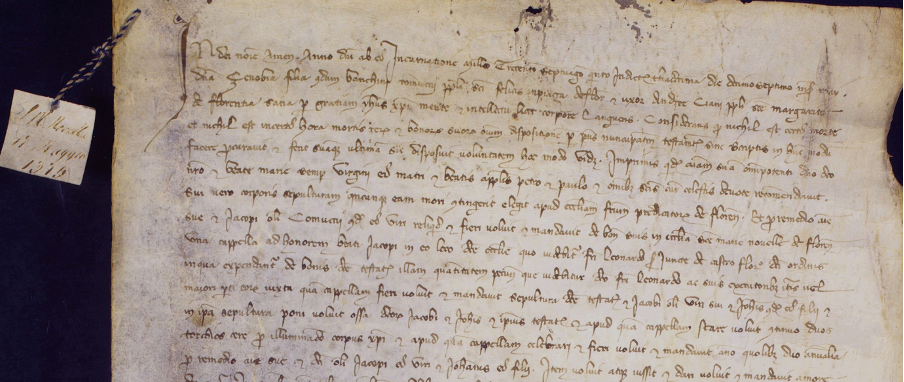
This married woman, Zenobia, daughter of the deceased Banchino, son of Comuccio, from Florence’s Soprarno parish San Felice in Piazza, was married at the time of her will (17 May 1375) to Andrea di Ciano from Florence’s eastern parish of Santa Margherita. Was it the usual will of a married Florentine woman with few, if any, choices or bequests, pious or non-pious, and which seemingly follow her husband’s wishes?
Beyond the notary’s initial identification of Zenobia, no further mention is made of her husband, that is, her living one, until the end of her testament. Unlike other testatrices within the SMN collection or from our much larger Florentine databases, Zenobia’s lists no mandualdus or consent from her husband, and she did not make a single itemized bequest to him. Her will, moreover, was not notarized at her conjugal home. Rather, she and her husband were separated during Zenobia’s spell of “languishing illness” and perhaps longer. She stayed in the home of Giovanna, widow of Dato, in the ancient parish of Sant’Andrea, across town in Florence’s central Mercato Vecchio.
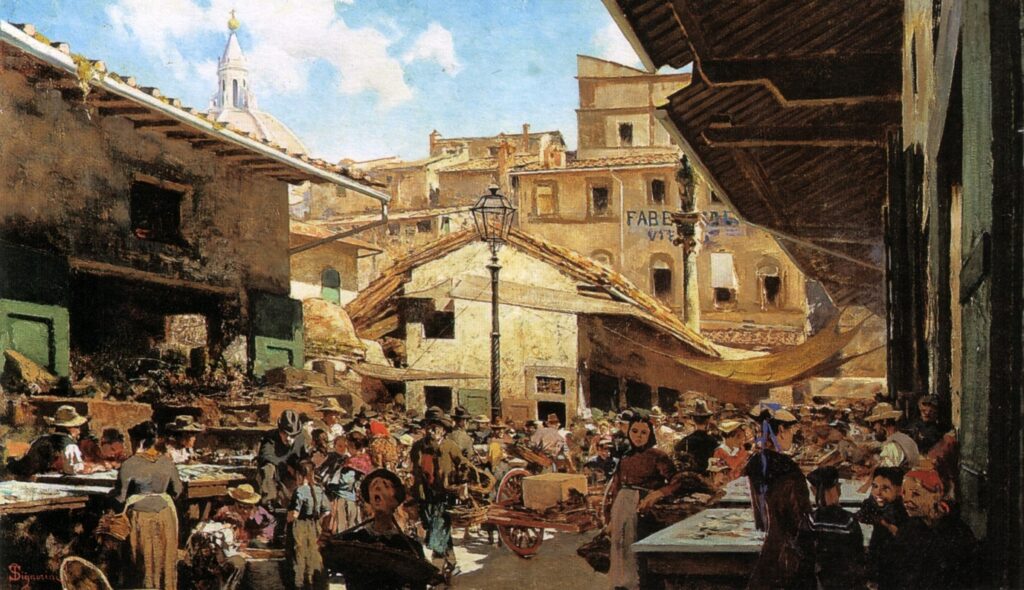
It was destroyed between 1885 and 1895
The major portion of Zenobia’s will, instead, concerned a previous husband no longer alive—Jacopus, son of the former Comuccius. Against notarial customs of identifying women by all their marriages, Jacopus was not initially named by the notary, despite this testament’s most detailed section focusing on him. These were two commissions, which planned two of the most substantial works found in the SMN testaments before 1398 by men or women, even though the SMN collection was highly elitist containing noble and mercantile testators, who bore some of Florence’s most prestigious family names–the Tornaquinci, della Tosa, Medici, Strozzi, Buondelmonti, and others. Yet Zenobia, along with her father and two husbands, was not distinguished by any occupations, titles, or family names. While she may have been wealthy, her testament gives no sign of Florentine elite status.
Both commissions involved her burial, that of the deceased Jacopo, and of their deceased son, Johannes. Zenobia first elected her grave within SMN. For the redemption of her soul and those of Jacopus and Johannes, she then ordered a chapel to be built within the church of SMN from her property (which her testament unfortunately does not specify). It was to be named in “The Blessed Jacopus” in honour of her first husband. Concerning the expenditures for constructing the chapel and presumably its accoutrements, she appointed the SMN friar Leonardo, son of the deceased Ser Juncta from Castelfiorentino.7 Her second commission concerned her sepulchre and was more detailed. From my present samples of testaments her demands were almost unique, not only for Florentine Florence but across Pisa and its territory, Rome and Lazio, Milan and parts of Lombardy.8 Both commissions involved her burial, that of the deceased Jacopo, and of their deceased son, Johannes. Zenobia first elected her grave within SMN. For the redemption of her soul and those of Jacopus and Johannes, she then ordered a chapel to be built within the church of SMN from her property (which her testament unfortunately does not specify). It was to be named in “The Blessed Jacopus” in honour of her first husband. Concerning the expenditures for constructing the chapel and presumably its accoutrements, she appointed the SMN friar Leonardo, son of the deceased Ser Juncta from Castelfiorentino.7 Her second commission concerned her sepulchre and was more detailed. From my present samples of testaments her demands were almost unique, not only for Florentine Florence but across Pisa and its territory, Rome and Lazio, Milan and parts of Lombardy.8 She instructed the removal of human bones (ossa) from one grave to be re-buried in another and these involved more than one set of bones. Next to her new chapel, the remains of her former husband and their son were to be transported to lie with her in her new grave.
To further memorialize her burial complex, Zenobia ordered two torches of wax to be kept alight in her chapel continuously to illuminate the body of Christ and two anniversary masses (annualia) to be celebrated there annually in perpetuity for the redemption of her soul and those of her deceased husband and son. By contrast, her testament never mentions the soul of her living husband. However, in her final act, the living husband finally appears and in a prominent place as her universal heir along with the inheritance of her deceased son («In omnibus …etiam ex hereditate supradicti Johannis eius quondam filii sibi suum universalem heredum instituit, fecit et esse voluit Andream supradictum eius virum»).11
What can we make of this testamentary story? How do we square Zenobia’s extraordinary choices over her burial commissions within a field where married Florentine women, in contrast to widows, were dependent on their husband’s consent and made few testamentary choices? Would Zenobia’s testament have been challenged immediately? If so, why would an established “imperial” notary have bothered to draft it? Had Zenobia brokered earlier a deal with the SMN friars and her seemingly estranged husband to elect him as universal heir and an executor of her estate but along with the abovementioned Leonardo and another SMN friar and her two carnal brothers, all with equal votes on any hereditary ruling?
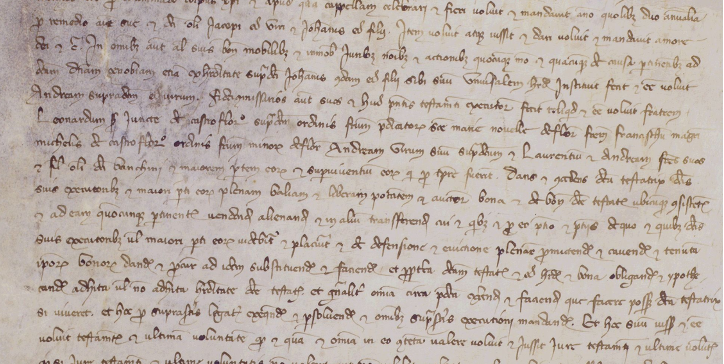
Further questions might also have arisen from SMN about Zenobia’s desire to cohabitate everlastingly with her ex-husband, while she banished all thoughts concerning the soul of the present one? Could these questions provide fertile grounds for historical fiction? How did the settlement arise? Did it depend on Zenobia’s masterful devotion, powers of persuasion, and administrative skills with SMN? Or for unexpressed causes, might the friars have been the prime movers? Certainly, Zenobia was brave and creative in requesting the double exhumation of her ex-husband and son, bringing them all together in her new family burial complex. To be sure, widows made commissions in their testaments for chapels for themselves and to enshrine their deceased husbands as with Fina Buzzacarina’s famous colossal conversion of Padua’s baptistry to honour her deceased husband.12 Zenobia’s was extraordinary in that she initiated her chapel to honour her ex-husband while her present one received not a single bequest or any mention of his soul.13 Had there been connubial violence that reached ecclesiastic courts; had the friars of SMN been asked to intervene?14 Was Zenobia’s will an unorthodox compromise?
Back to history and its contexts built quantitatively from SMN’s 132 wills compared with 5,11615 across Florentine Tuscany and another 2,000 testaments from Pisa and its territory. Even without speculations on Zenobia’s relationship with her second husband and extraordinary devotion to the first one, her testament runs against the grain of testaments, customs, and law for Florentine Tuscany, where married women came of age only in widowhood. The usual strategy in linking the quantitative with the qualitative has been to enliven statistical trends with small numbers of narrative examples to lend the bare bones of number some flesh. The case above does the opposite. By highlighting the exceptional resistance of one woman out of step with the underlying conditions of married life and death in Florentine Tuscany, a precious peephole into the emotional past of Renaissance Florence has been pried open, when laws and customs constrained married women’s last choices of over their properties and souls far greater than for widows.
- The ASF online collection in Instituto Centrale per gli Archivi (ICAR) contains 564 fondi mainly from ecclesiastical institutions but also from family and municipal archives. Fortunately, this is not the case with the online parchment collections for Pisa or Lucca where the photographed collections are complete. ↩︎
- These consist of 5,116 testaments and codicils found in the protocolli of the ASF, Notarile antecosimiano[hereafter Not. antecos.] From the earliest testaments, our collections of coded testaments continue until 1525. ↩︎
- On the social status of the residents in these parishes, see my Laboring Classes in Renaissance Florence(New York: Academic Press, 1980); and The Black Death Transformed: Disease and Culture in Early Renaissance Europe (London: Arnold, 2002), pp. 173-4. ↩︎
- Hughes, “Domestic Ideals and Social Behavior: Evidence from Medieval Genoa,” 115-43, in The Family in History, ed. Charles E. Rosenberg (Philadelphia: University of Pennsylvania Press, 1975), p. 142. ↩︎
- J.P. Goldberg, Women, Work, and Life Cycle in a Medieval Economy: Women in York and Yorkshire c. 1300-1520 (Oxford: Clarendon Press, 1992), pp. 330-3; 342-4, 359. ↩︎
- If a pinzochera were identified as a widow, I counted her as a widow. No pinzochera in my samples was married. ↩︎
- This chapel does not exist today in SMN and is not mentioned in Walter and Elisabeth Paatz, Die Kirchen von Florenz: ein Kunstgeschtliches Handbuch (Frankfurt am Main: V. Klostermann, 1952-5) Volume III,
Santa Maria Novella, 663-845. This is not evidence of the commission not having been executed since the chapel may have been demolished. ↩︎ - Thus far, I have found only one other case of testator ordering the exhumation and reinterment of human remains: Gino di Neri di Gino, from the important Florentine family of the Capponi ordered in his testament on 24 March 1480 (1479 Florentine style) that the ones of his ancestors («ossa suorum predecessorum») be reburied in his newly constructed sepulchre in the church of Santo Spirito in its newly built section. He did not, however, indicate where these ancestors had been buried and how many bodies would be exhumed; ASF, Not. Antecos., no. 11654, 115r-v. ↩︎
- This chapel does not exist today in SMN and is not mentioned in Walter and Elisabeth Paatz, Die Kirchen von Florenz: ein Kunstgeschtliches Handbuch (Frankfurt am Main: V. Klostermann, 1952-5) Volume III,
Santa Maria Novella, 663-845. This is not evidence of the commission not having been executed since the chapel may have been demolished. ↩︎ - Thus far, I have found only one other case of testator ordering the exhumation and reinterment of human remains: Gino di Neri di Gino, from the important Florentine family of the Capponi ordered in his testament on 24 March 1480 (1479 Florentine style) that the ones of his ancestors («ossa suorum predecessorum») be reburied in his newly constructed sepulchre in the church of Santo Spirito in its newly built section. He did not, however, indicate where these ancestors had been buried and how many bodies would be exhumed; ASF, Not. Antecos., no. 11654, 115r-v. ↩︎
- ASF, Diplomatico, Santa Maria Novella, 17 May 1375. The notary was Ser Gregorius filius quondam Ser Franceschi Ser Baldi de Florentia. Three of his notarial flize survive: nn. 10206 (1391-5), 10207 (1395-8), and 10208 (1391-5). Unfortunately, his earlier work in the 1370s does not survive. Two further contracts in 1391 and 1394 are found the SMN Diplomatico collection; both concerned the elite guild of the Calimala. ↩︎
- The bibliography on Buzzacarini and her commissions is lengthy; see for instance Anne Derbes, Ritual, gender & narrative in late medieval Italy: Fina Buzzacarini and the baptistery of Padua (Turnhout: Brepols 2020). ↩︎
- From my Florentine Tuscany dataset, married women accounted for only 148 of the testators (2.9%). Of these, at least as indicated in their testaments, only 16 had previous marriages, and none chose to be buried in the tomb or church of her first husband. For widows without a living husband who could refuse to legitimate her testament, it was different. Although the number of widow testatrices exceeded those of married women by almost nine times, notaries identified only 17 widows with more than one previous husband. For four, no burial choice was expressed; for another four their burial places were not connected to either husband; four others chose to be buried in the sepulchre of their first husband, and five for burials in their last husband’s grave. ↩︎
- Cases of violence between spouses, if it did not result in murder, were usually tried in ecclesiastic tribunals. ↩︎
- This number is larger than the 5,038 figure of testators mentioned earlier because of damages to the records whereby testators’ social class cannot be evaluated. ↩︎